



Sunken Devastator torpedo bomber from WWII may become first of its kind in a museum
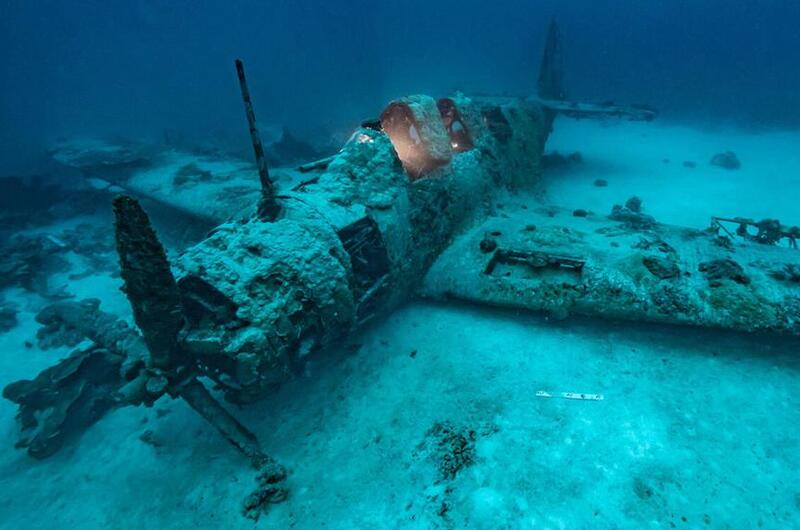
The largely intact wreck of Devastator torpedo bomber BuNo 1515, ditched by its crew on Feb. 1, 1942, lies on the floor of a Marshall Islands lagoon in this undated photograph.
By Wyatt Olson | Stars and Stripes March 19, 2026
The Devastator torpedo bomber’s role in World War II was short-lived but historic.
U.S. Navy pilots flew the TBD-1 Devastator against the Japanese in the 1942 Battles of Coral Sea and Midway. Developed by Douglas Aircraft Co. in 1937, the Devastator was the Navy’s first carrier-based plane with an enclosed cockpit.
The 129 Devastators produced by Douglas, however, were already outdated and quickly replaced by the speedier, nimbler Grumman TBF Avenger.
The Devastator became a footnote in history, and no vestige of the bomber is found in any museum or collection anywhere in the world.
Now, the Devastator Rising Project is intent on changing that by retrieving a nearly intact wreck resting in a shallow Pacific lagoon for future display in Washington, D.C.
A consortium formally launched the project in January. It is composed of the Air/Sea Heritage Foundation, the Naval History and Heritage Command, Texas A&M University’s Center for Maritime Archaeology and Conservation and the Marshall Islands Cultural and Historic Preservation Office.
But reclaiming a Devastator from the sea has been a decades-long avocation for Russ Matthews, director of the Air/Sea Heritage Foundation based in Boise, Idaho, he said in a Feb. 17 phone interview.
Matthews described himself as a lifelong aviation junkie, with a particular interest in the Battle of Midway in June 1942. The story of the Devastators “grabbed him,” he said.
In 2003, he became involved in a project by the International Group for Historic Aircraft Recovery that set out to document a pair of Devastators resting 120 feet below the surface of Jaluit Lagoon in the Marshall Islands. Divers had discovered the largely intact planes six years earlier.
Based on seven expeditions to the wrecks over about 20 years — during which the Air/Sea Heritage Foundation was established in 2017 — data indicated that the plane identified by Bureau Number 1515 would be the best candidate for recovery, Matthews said.
BuNo 1515 had been part of a group that flew from the Yorktown on Feb. 1, 1942, for a shore bombardment of the Marshall Islands.
But the plane, along with BuNo 0298, encountered bad weather and drifted off course. Realizing they did not have enough fuel for the return trip, the crews jettisoned their bombs and ditched the planes in the lagoon.
Japanese troops captured the crews on a nearby island the next day, and they spent almost four years as POWs. All returned home after the war.
Naval History and Heritage Command first and foremost wants to recover BuNo 1515 because it would at long last bring an example of the aircraft to a museum, Samuel Cuellar, an underwater archeologist leading the effort on behalf of the command, said by phone Wednesday.
The plane may be retrieved in the summer of 2028 at the earliest, he said.
Plans call for putting it on permanent display at the new National Museum of the United States Navy, which is expected to open in 2030.
Beyond that, Cuellar said, the artifact will highlight the tales of the men operating the Devastators.
Despite flying obsolete, outgunned aircraft, “they still went forth,” he said.
“These were some of the first encounters that American pilots had with the Japanese in some of these engagements,” Cuellar said. “That is also something that’s really important, to be able to tell the story, not only of the planes, but more importantly, the pilots that flew them and the crews that manned them.”