



For some military families, adoption forges bonds that span borders and generations
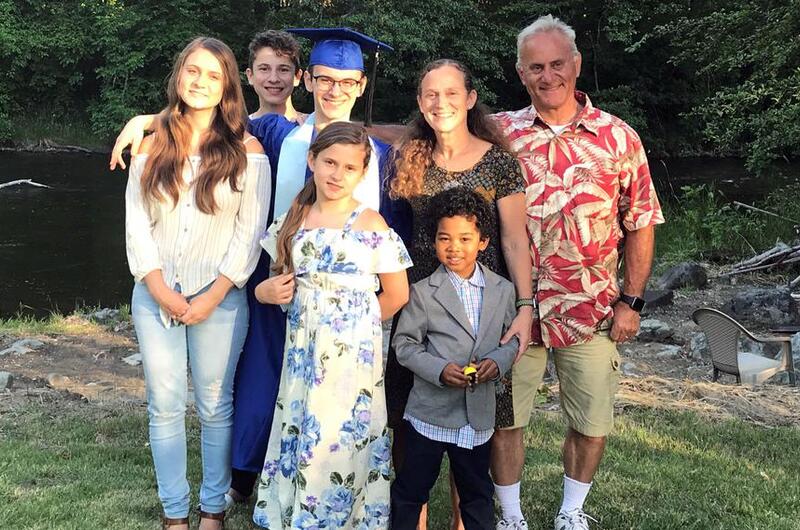
Susie and Michael Paul pose with their four biological children and their adopted son, Benaiah, in Applegate, Ore., in 2020.
By Alex Wilson and Yoojin Lee | Stars and Stripes January 14, 2026
Fifty years ago, U.S. Navy Cmdr. Dixie Dunham set out to adopt a child while stationed at what is now North Dock in Yokohama, Japan.
Months later, after rounds of interviews, piles of paperwork and two trips to South Korea, she returned not with one child, but three. Laurie, 10, Mija, 8, and Christin, 4, came to live with her in November 1975.
Dunham was 46 at the time, single and keenly aware of social changes taking place around her. “In today’s world I can have a career and a family, too — the best of both lives,” she told Stars and Stripes in February 1976.
One of her daughters, Christin Dunham, is now 54 and works as a librarian at Osan Middle High School on Osan Air Base, south of Seoul.
“I always tell people, you know, blood doesn’t make a family. You could have biological family members you can’t stand,” she told Stars and Stripes at Osan in November. “I say love makes a family.”
While adoption within American military families is not unusual, service members pursue it less frequently than the overall U.S. population.
Between 2016 and 2020, just 2,174 military families fostered or sought to adopt children, according to a 2021 Government Accountability Office report. That figure represents less than 1% of the approximately 1.3 million military members serving during that period.
By comparison, an estimated 2% to 4% of American families have adopted children, and as many as 33% have considered it, according to the Adoption Network website.
Still, for those who do adopt, military life — particularly overseas — can shape family experiences in distinctive ways, from international adoptions decades ago to raising children in diverse base communities and, in some cases, reconnecting adoptees with their countries of origin.
Susie Paul, 56, and Michael Paul, 71, a teacher at Osan, adopted their son, Benaiah, 11, when he was 2. The family said the military community has played an important role in his upbringing.
“One of the really good things about being here, I think in Korea, especially, is there are so many different cultures represented on the base,” Susie Paul, a stay-at-home mother, said by phone in November.
“He absolutely fits right in; he’s accepted,” she said. “There are so many mixed families and that sort of thing — people coming and going — I think it’s been a great environment to raise him.”
The couple, who also have four biological children, adopted Benaiah from a family friend after fostering him unofficially for several years.
“We really wanted a big family — we love kids — and so we wanted to explore adoption,” Paul said. “We felt like if God wants us to do that, then he’s going to place a child in our lives, and he did.”
Paul emphasized that adoption can be deeply rewarding but comes with challenges.
“I will never go down without saying that … but I think overall it’s a really good thing,” she said.
Military service has also influenced some adoptees’ efforts to search for their biological families.
At 18, Scott Gleason decided he wanted to reconnect with his Korean birth parents, but his attempts were unsuccessful until he joined the U.S. Army, he said by phone in November.
Gleason — now 32 and a lieutenant assigned to U.S. Army Japan — completed a year-long tour in South Korea beginning in 2023. During that time, he searched for information about his birth family.
“I found out I have a biological mother who’s still alive — they don’t know anything about my father,” he said. “And then she has a sister, my aunt, who’s still alive, but when the adoption [agency] reached out to them, they weren’t interested in connecting.”
Although the outcome was disappointing, Gleason said he made peace with it.
“I went and tried,” he said. “I lived out there for a year. I was traveling out there on the weekends. I feel like I’ve extinguished every option, and I’m satisfied. You know, I think I gave it an honest effort.”