



Memorial honors WWII soldiers torpedoed in Hawaii waters in 1942
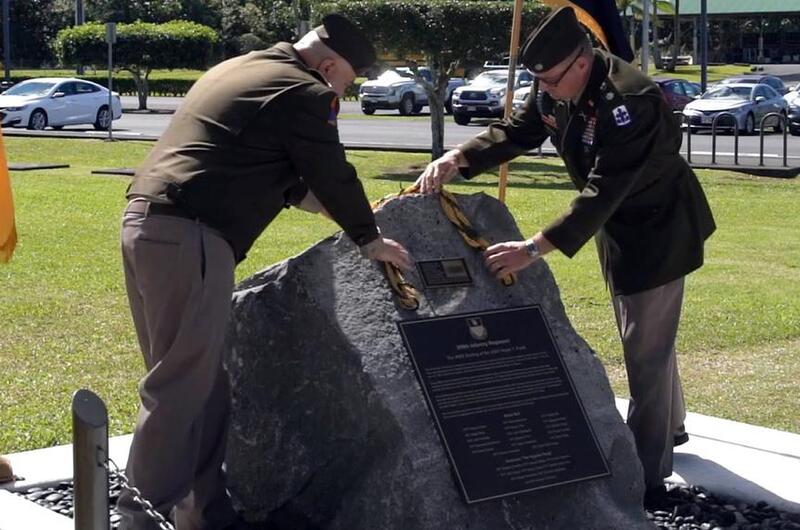
Members of the Hawaii Army National Guard unveil a memorial on Jan. 28, 2026, at Keaukaha Military Reservation in Hilo, Hawaii, honoring the 17 guardsmen who died and nine who survived a torpedo attack near Maui during World War II.
By Wyatt Olson | Stars and Stripes January 30, 2026
FORT SHAFTER, Hawaii — The Hawaii Army National Guard dedicated a memorial Wednesday on the state’s Big Island honoring the 26 guardsmen aboard a transport boat sunk by a Japanese torpedo while near Maui in January 1942.
Seventeen soldiers died in the attack, and nine survivors went on to fight throughout World War II. In the years to come, the survivors dubbed themselves the “Torpedo Gang.” None are now alive.
Eight of them were of Japanese descent and served in Europe in the 100th Infantry Battalion, a unit made up almost entirely of Japanese-Americans.
The names of all 26 are inscribed on the memorial’s bronze plaque at the Keaukaha Military Reservation in Hilo.
“It was an uncertain time that was rife with fear of invasion and racial suspicion of the very soldiers whose memory we’re here to honor, who were Americans of Japanese ancestry — as were a majority of the soldiers there on this plaque,” Lt. Col. David Hosea, a member of the Hawaii Army National Guard, said during the ceremony.
The sinking happened in the dark days soon after the Japanese surprise attack on Hawaii on Dec. 7, 1941. Survivors recalled the Army ordering them not to talk about the sinking.
The guardsmen had completed basic training at Schofield Barracks on Oahu and were returning to the Big Island on Jan. 28, 1942, aboard the USAT Royal T. Frank, a 100-foot transport boat.
It was part of a three-vessel convoy when torpedoed while crossing the Alenuihaha Channel, a 30-mile wide strait separating Maui and Hawaii Island.
Also in the convoy was a Navy destroyer and a small freighter towing an ammunition barge.
Japanese submarines were a constant danger in Hawaiian waters in those early days of war and had already sunk three ships before the Royal T. Frank went down, according to an article on the sinking published in 2012 in the National Archives’ Prologue Magazine.
Survivor George Taketa recalled in a 1995 National Guard newsletter that he was sleeping on a mailbag above deck because the lower deck was too noisy and smoky to sleep.
When the torpedo struck at around 7 a.m., all those in the lower deck died immediately, according to the National Archives article. The captain of the boat was killed by shrapnel, and the boat sank within a minute.
“Covered in oil, the survivors spent hours in the ocean, many clinging to whatever debris they could, before they were picked up by the ammunition barge that had been the actual target of the Japanese submarine,” the article states.
Taketa had held onto the mailbag as he slipped into the water. The bag was buoyant and kept him afloat until being rescued.
Of the 60 people on board, only 36 survived, the nine guardsmen among them.
Roughly two years later, the submarine that sank the transport boat was itself sunk near New Guinea by American depth charges.
The wreck of the Royal T. Frank has never been located, according to the National Archives article.