



Japanese neighborhood preserves memory of WWII crash and its cost
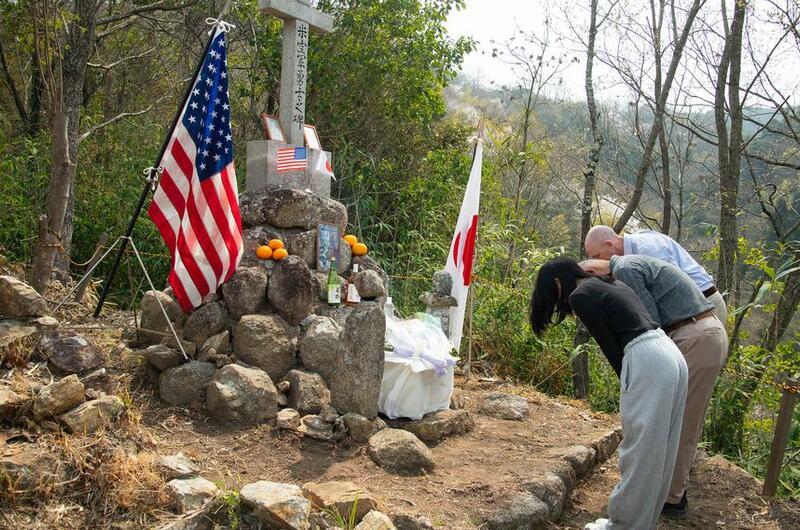
People pay their respects at the Marukoyama Memorial in Kure, Japan, March 28, 2026. The monument honors the lives lost when an American torpedo bomber was shot down in the closing days of World War II.
By Janiqua Robinson | Stars and Stripes March 31, 2026
KURE, Japan — A recent gathering in this city on Japan’s Inland Sea kept alive the memory of an American torpedo bomber shot down in the closing days of World War II and the lives lost as a result.
About 75 people, including approximately 30 Marines and sailors from Marine Corps Air Station Iwakuni, attended the annual Marukoyama Memorial Ceremony on Saturday to commemorate the events of July 24, 1945.
Two of the three aviators aboard a U.S. Navy TBM-3 Avenger and four city residents died in the plane crash and resulting fire, according to the program prepared by the Fujinowaki Neighborhood Association.
A Japanese farmer retrieved the remains of the pilot, Lt. j.g. Clarence Arthur Tiege, and buried them on his farm. Tiege’s remains were later recovered and reinterred in Hawaii.
“This spot is really important because it brings not only the two cultures together, but it recognizes that there is a cost to war,” MCAS Iwakuni Command Chaplain (Navy Lt.) John Pollnow told Stars and Stripes after the ceremony.
“There is a cost to the things that we do in the military. We know this in peace. We know this right now — that we are in conflict, and that lives do expire,” he said. “It is really important for us to remember that peace has a price.”
The Avenger’s radioman, Petty Officer 3rd Class Jack Spencer Keeley, was presumed dead in the crash.
Petty Officer 3rd Class Luther Pope Johnson Jr. survived, evaded capture for two weeks in the local wilderness and was interned as a prisoner of war at Ofuna, according to an April 13, 2025, article on the MCAS Iwakuni website.
Johnson died in October 2006, the same year local volunteers restored a trail leading to the site and the neighborhood association started hosting annual ceremonies there.
Twelve houses were destroyed in the fire 81 years ago, and residents at the time turned their anger and grief on the remains of the pilot they found in the ruins.
“At that time, the people were impacted by the war, and their frustration and grief had nowhere to go,” Jiro Takahashi, association chairman, said through translator Hiroyuki Fukao during the ceremony.
“In that moment, Mr. Kazuzou Furukawa, the head of the district, spoke to the people and admonished them, saying, ‘Surely this man also has parents, how would they feel?’ After that, he buried the remains of the foreign soldier on his own farmland and offered prayers for him,” Takahashi said.
Furukawa’s eldest son was killed in action on New Britain Island seven months before the crash, according to the program. His eldest daughter went missing on Aug. 6, 1945, when the United States dropped an atomic bomb on nearby Hiroshima. His wife was exposed to radiation while looking for her and also died.
After the two countries established a lasting peace in September 1951, Furukawa built a large monument on a hill in Marukoyama to mourn his wife and children. Next to it, he placed a stone with the symbolic inscription, “Grave of the U.S. Air Force Brave Flyers,” according to the program.
Furukawa maintained the trail to the monument for years but following his death, few knew about the site.
“We have inherited this from the life of Mr. Kazuzou Furukawa, a deep sense of mourning for those who lost their lives, as well as the hopeful wish to break the cycle of hatred,” Kazuaki Kurotobi, vice chairman of the neighborhood association, said during the ceremony.