



He died in a Korean War prison camp. Now Emil Kapaun could become the US military’s first saint.
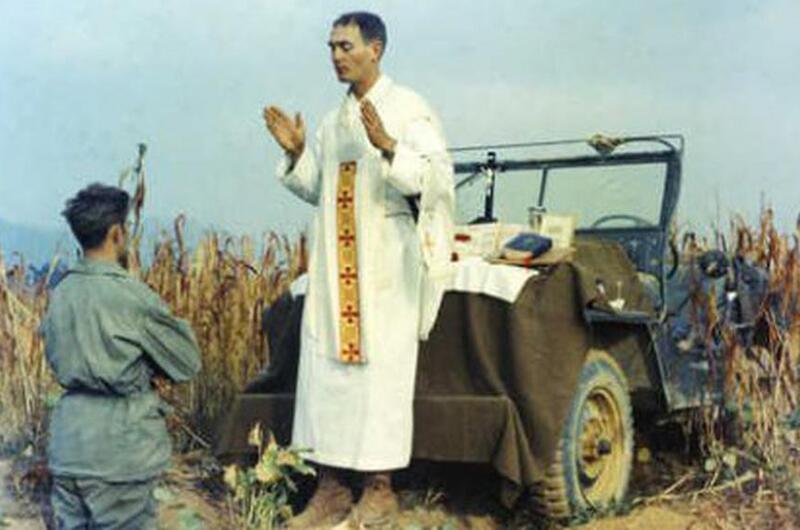
Rev. Emil Kapaun celebrates Mass beside a Jeep during the Korean War. The Army chaplain, who died in a Chinese prison camp in 1951, is now being considered for sainthood by the Catholic Church.
By Lara Korte | Stars and Stripes May 22, 2026
The last time Paul Roach and Mike Dowe had seen the Rev. Emil Kapaun, he was being taken away by prison guards during the Korean War — sick, shivering and near death.
More than 70 years later, in 2021, the two former Korean War prisoners traveled to Kansas to finally view the remains of their friend, the beloved Army chaplain, after the military identified Kapaun among unknown soldiers buried in Hawaii, finding remains long thought to be lost forever.
Kapaun would be welcomed home to Wichita by a crowd of more than 6,000 people and finally given a proper burial. But before the congregation paid its respects, the two aging veterans, who had been imprisoned alongside Kapaun, gathered for a private viewing beside the chaplain’s flag-draped casket.
As soon as Kapaun’s remains were uncovered, Roach and Dowe recognized their friend immediately.
“That’s his smile!” Roach said, recalled the Rev. Matthew Pawlikowski, a retired Army chaplain who accompanied the men to the viewing. “Even in death, he was bringing joy to people.”
Kapaun’s capture and death at the hands of Chinese forces during the Korean War earned him the Medal of Honor and a lasting reputation among generations of soldiers and chaplains.
He’s the namesake of a number of sites on overseas U.S. military installations, including the chapel at Camp Humphreys in South Korea and Kapaun Air Station in Kaiserslautern, Germany.
Now, 75 years after his death, Kapaun is being considered for an even rarer distinction — sainthood.
In recent years, the Catholic Church has begun investigating claims of miracles tied to Kapaun — part of the Vatican’s formal process for determining sainthood — including medically unexpected recoveries that many Catholics attribute to his intercession.
Last year, shortly before his death, the late Pope Francis named him “venerable.”
Pending further investigation by the Vatican, he could become the first U.S. military service member declared a saint by the Catholic Church.
Son of Kansas farmers
Kapaun knew he wanted to be a priest from an early age.
Born to Czech immigrant farmers in Pilsen, Kan., he used to stack cardboard boxes in the living room and pretend to celebrate Mass, according to family stories.
After seminary, Kapaun began serving the Czech community in his hometown. But after his younger brother Eugene returned from World War II in 1944 — having taken part in the Normandy invasion — Kapaun began reconsidering where he could do the most good.
Later that same year, Kapaun joined the Army Chaplain Corps, serving in India and Burma during the war. After returning home and completing a master’s degree on the G.I. Bill, he reenlisted.
“I think he felt he could do more for the soldiers than he could for the parish,” said his nephew, Ray Kapaun.
In early 1950, his unit deployed to Japan as part of the postwar occupation force. Within six months, North Korean forces invaded South Korea.
Weeks later, Kapaun’s unit — the 8th Cavalry Regiment, 1st Cavalry Division — became part of the first U.S. forces sent into the Korean War. In letters home, he wrote optimistically that the fighting might end by Christmas.
Instead, Kapaun and thousands of other American soldiers were captured before Thanksgiving.
‘He was all GI’
Kapaun might have been a man of God, but fellow soldiers said he carried no holier-than-thou attitude. Dowe, a young lieutenant when he was imprisoned alongside Kapaun, later wrote extensively about the chaplain’s service.
“Outwardly he was all GI, tough of body, rough of speech sometimes, full of the wry humor of the combat soldier,” Dowe wrote in a 1954 article for the Saturday Evening Post.
Kapaun often risked his life to retrieve wounded troops and administer last rites. He would sometimes drop into foxholes to comfort nervous riflemen, offering a fresh peach and a joke before moving to the next soldier.
He carried the tools for the sacraments with him across the battlefields of Korea, often celebrating Mass on makeshift altars of ammunition boxes or the hoods of Jeeps.
Once, while rushing to rescue a wounded soldier, he came under such heavy fire that his smoke pipe was shot out of his mouth. For his bravery in action, he received the Bronze Star Medal.
It was this devotion to the wounded, Dowe wrote, that would ultimately cost him his freedom and later his life.
In November 1950, during a battle near Unsan after Chinese forces entered the war, Kapaun worked to retrieve wounded troops and anoint the dying. At one point, he was offered a chance to escape but refused, opting instead to stay behind with the injured soldiers.
Shortly thereafter, he was captured and forced to march for dozens of miles with other American forces to a prison camp at Pyoktong. It was here that Dowe met Kapaun, who was moving up and down the line encouraging soldiers to help carry the wounded lest they be shot for falling behind.
Pawlikowski, the retired chaplain who now serves as a civilian at West Point, has spent much of his career sharing Kapaun’s story. What stands out to him most, he said, is that Kapaun never seemed larger than life — just deeply committed to helping others.
“Service is another word for love,” Pawlikowski said. “I tell people that there’s nothing he did in his story that you couldn’t do. It’s just that he did it.”
Prisoner of war
Kapaun spent the next seven months in Prison Camp No. 5 tending to fellow detainees — skirting rules and defying prison guards even as his own physical condition deteriorated.
He would often sneak off to scrounge for additional food to supplement the meager rations of millet or cracked corn given to prisoners, saying a prayer to St. Dismas, the Good Thief, as he stuffed grain into his pockets.
Prohibited from tending to the wounded in the sick house, he’d sneak past guards to visit them, washing their old bandages, picking lice from their bodies and holding them in his arms when they became overcome with delirium. He said prayers for them, joked with them, and urged them not to lose hope.
Dowe later wrote that another prison camp known as Death Valley had similar conditions but a death rate 10 times higher — a difference he attributed to Kapaun’s tireless work and positivity.
“The main thing he did for them was to put into their hearts the will to live,” Dowe said. “For when you are wounded and sick and starving, it’s easy to give up quietly and die.”
Despite threats and communist indoctrination attempts, Kapaun continued ministering to the soldiers, quietly and calmly pushing back against anti-religious propaganda.
But Kapaun’s health was failing. On Easter Sunday 1951, he gathered soldiers in a burned-out churchyard to listen to the Easter readings in defiance of prison rules. The following week, he began limping on a swollen and discolored leg from what was likely a blood clot.
The next Sunday, as he led the men in prayer, his voice faltered and he fainted, Dowe recalled. Though his leg improved, he was soon struck by dysentery that left him delirious with fever.
He later began to improve, eating and joking with the others. But the Chinese guards did not intend for him to live, Dowe wrote. As they came to take him to the sick house, the men protested, knowing he would be left to die in freezing filth.
But Kapaun himself did not object.
“Tell them back home that I died a happy death,” he said, per Dowe’s account.
He died a few days later, on May 23, 1951, at the age of 35.
For years, the location of Kapaun’s remains was disputed. Many former POWs believed he had been buried in a mass grave, while others swore he was buried alone. Later, his family learned he had been moved to Hawaii as part of Operation Glory, the effort to repatriate Americans who died in the Korean War.
Once thought to be lost forever in a rural part of North Korea, Kapaun had actually rested among fellow unknown service members at the National Memorial Cemetery of the Pacific in Honolulu since 1954.
Miracles
For decades, Catholics, chaplains and soldiers shared Kapaun’s story as an example of sacrifice and service to others. Then, in the early 2000s, reports of medically unexpected recoveries began drawing the attention of the Catholic Church.
Supporters of Kapaun’s sainthood campaign point to at least three cases in the Wichita area between 2006 and 2011 involving people who recovered after prayers to the late chaplain.
The Rev. Eric Weldon, a priest in the Diocese of Wichita, was serving at St. Patrick’s Church in 2006 when he learned that one of his parishioners, a 12-year-old girl named Avery Gerleman, was gravely ill.
Gerleman, who had an autoimmune disorder, had been in a coma for weeks. Multiple organs, including her lungs and kidneys, were failing. Weldon, a former Army Reserve lieutenant who had attended Kapaun Mt. Carmel High School in Wichita, asked his congregation to pray to Kapaun on All Saints’ Day.
“I just straight up said, ‘Avery Gerleman, in our parish, she’s in the hospital and she’s going to die,’ ” Weldon recalled. “ ‘So we’re going to ask for Father Kapaun’s intercession.’ ”
Days later, Gerleman began emerging from the coma. Within weeks, her kidneys and lungs recovered. Later, doctors reportedly told Vatican investigators they were unable to find a sufficient medical explanation for her recovery.
“It was very emotional,” Weldon said.
The Catholic Church is currently examining Kapaun’s life as part of the process to potentially declare him a saint. The Diocese of Wichita says it has already sent more than 8,000 pages of research to the Vatican.
In addition to Gerleman’s case, supporters point to the recoveries of Chase Kear, a college student who survived a severe head injury after a 2008 pole-vaulting accident; and Nick Dellasega, who collapsed during a 5K race in 2011 and appeared to die before ultimately surviving.
Last year, the Vatican gave Kapaun the title “venerable,” the second step toward sainthood. If the Church verifies one miracle, he’ll be eligible to receive the title “blessed.” A second verified miracle would be required for sainthood.
For Ray Kapaun, the campaign around his uncle has been surreal. He jokes that he sometimes feels extra pressure to be the last person to leave church or behave a certain way because of his connection to a potential saint.
Ray Kapaun said his grandmother was able to see some of the enthusiasm around Kapaun, including early calls for sainthood, before she died in the 1980s, but her primary focus remained on his return.
“She got to see some of that momentum,” he said. “But I think … she just wanted her son home more than anything.”
‘Not beyond reach’
Today, Kapaun’s remains rest in the Cathedral of the Immaculate Conception in Wichita, but his story has traveled around the world.
When asked why his life resonates so much, those who follow Kapaun often bring up a common theme — his humanity.
He’s not the typical saint depicted on prayer cards or paintings, with hands gently folded and eyes looking upward, Pawlikowski said. He struggled and experienced incredible hardship, but he still had a sense of humor and joy, he said.
“I think he’s a saint that’s not beyond reach,” Pawlikowski said.
All of the men imprisoned alongside Kapaun have now died. Dowe died in 2025. The final surviving member of “Father Emil’s Boys,” Roach, died last month.
Today, Ray Kapaun lives on a little island in Puget Sound, north of Seattle. When Stars and Stripes spoke to him, he was looking out over the same waters his uncle crossed when he left the U.S. for Japan in 1950.
Ray Kapaun recalled his father often retelling the story of the last time he saw his brother in Kansas, just a few weeks before he shipped out. The chaplain pulled his younger brother aside and told him he felt it would be his last trip.
“He said, ‘don’t say anything to mom and dad, but I don’t think I’m going to be coming back from this one,’ ” he recalled.
When his brother objected, the chaplain insisted he wasn’t trying to upset him, but to reassure him he was at peace with the prospect.
“He was willing to give his whole life to what he was doing, without having that fear of anything,” Ray Kapaun said. “He knew that was his mission in life.”